
Free Resource
Fair Value Gap (FVG) Explained: How to Spot It and Trade It Without Getting Chopped Up

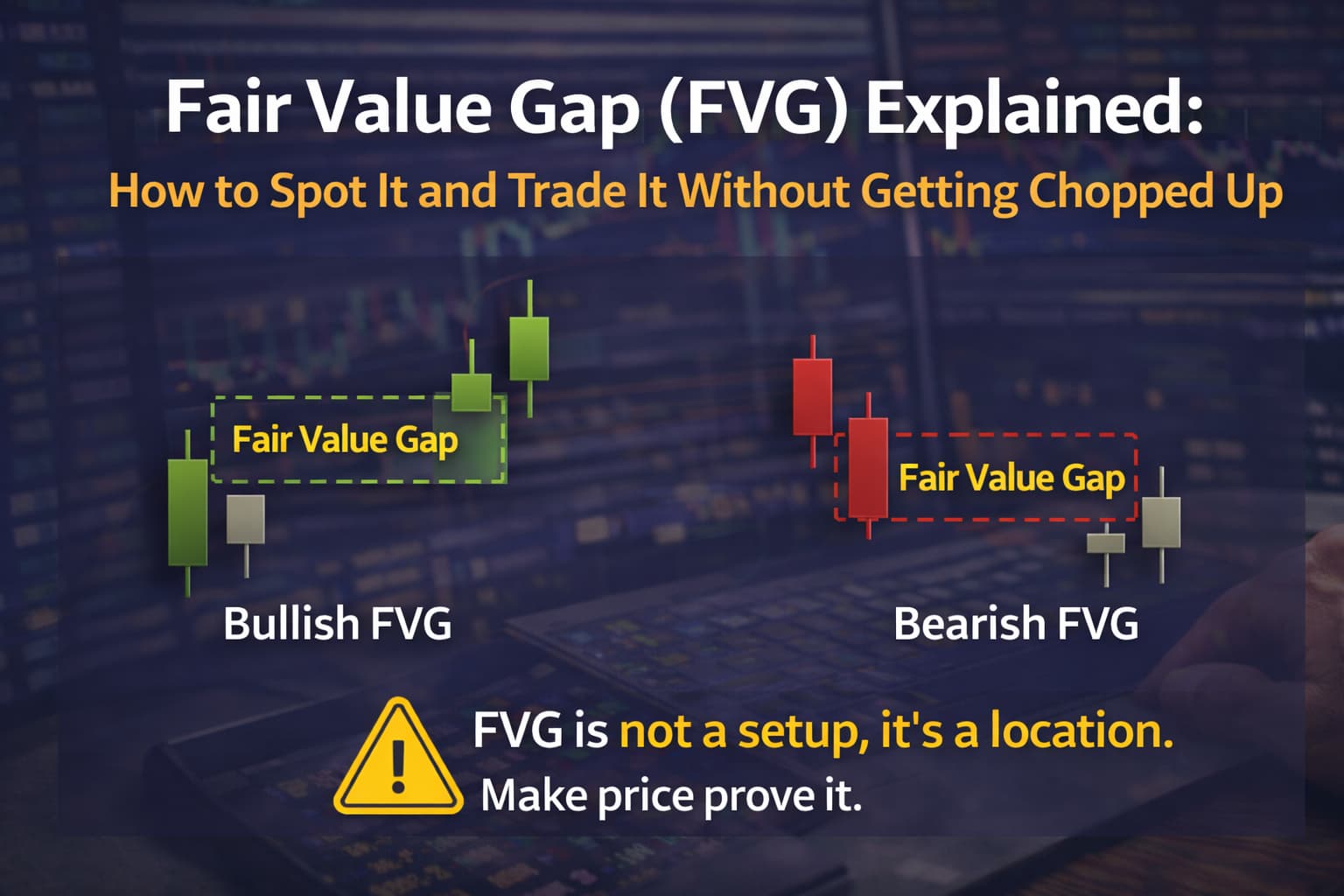
I used to think a “fair value gap” was some secret smart-money doorway that only the chosen few could see.
Then I actually started marking them on charts and realized the truth: an FVG is just the market moving so aggressively that it leaves unfinished business behind. Sometimes that unfinished business matters. Sometimes it’s just another shiny rectangle that makes you feel productive while you lose money.
So if you’ve been drawing FVG boxes everywhere and wondering why price keeps touching them, laughing at you, and moving on… you’re not alone. The concept is solid. The way most people use it is not.
Quick note before we start: educational only, not financial advice. If you blow up because you fell in love with a rectangle, that’s between you and your keyboard.
What a fair value gap actually is (in normal language)
A fair value gap is a three-candle pattern that shows imbalance. Price moves hard in one direction, and in that move there’s a “gap” between candle 1 and candle 3 that didn’t get traded through.
That gap is the “unfinished” area.
The reason people care is simple: markets love revisiting unfinished areas. Not because of magic. Because liquidity, order flow, and efficiency. The market often comes back to rebalance what it skipped.
The important part: an FVG is not a guaranteed reversal zone. It’s a location where a reaction is more likely, if the rest of the story makes sense.
The clean way to identify an FVG (without the guru poetry)
Forget candle color for a second and just look at the structure.
You’re looking at three candles:
- Candle 1
- Candle 2 (the displacement candle, usually the “big” one)
- Candle 3
Bullish FVG (price moved up hard)
A bullish FVG forms when:
- The high of candle 1 is below the low of candle 3 (no overlap)
Your zone is:
- Bottom of the box: candle 1 high
- Top of the box: candle 3 low
When price comes back down into that box later, traders look for a bounce or at least some reaction.
Bearish FVG (price moved down hard)
A bearish FVG forms when:
The low of candle 1 is above the high of candle 3 (no overlap)
Your zone is:
Top of the box: candle 1 low
Bottom of the box: candle 3 high
When price comes back up into that box later, traders look for a drop or a reaction.
That’s it. It’s not more complicated than that.
Here’s the part nobody wants to accept: you can identify FVGs perfectly and still lose if you trade them like a “touch = entry” button.
Why FVGs work sometimes and fail other times
The theory people repeat is “fair value changed.” Fine. Here’s how I think about it without turning it into a bedtime story.
When price moves violently, there’s usually real participation behind it. That move often leaves areas that didn’t get properly traded. Later, when the market needs liquidity or wants to rebalance, it revisits those areas.
But here’s what ruins most people:
They trade every FVG the same way, regardless of where it formed, what trend the market is in, what session it is, and whether that move was even meaningful.
So let me give you the practical version.
“An FVG is not a setup. It’s a location. The setup is what happens when price gets there.”
That mindset alone filters out a lot of dumb trades.
The beginner mistake: turning FVG into a “zone religion”
Most beginners do one of these:
- They enter the moment price touches the box.
- They set their stop inside the box because “tight risk.”
- They expect a clean reversal because the box exists.
Then price taps the zone, wicks through it, stops them, and moves exactly as expected.
And they call it manipulation.
It’s not manipulation. It’s you trading a location without confirmation.
FVG vs other “zones” (quick table so your brain stops mixing them)
| Concept | What it represents | Strength | Common beginner mistake |
|---|---|---|---|
| Fair Value Gap (FVG) | Imbalance from displacement | Good when aligned with structure | Treating every touch as entry |
| Supply/Demand Zone | Area where price previously turned | Can be strong but subjective | Drawing huge zones everywhere |
| Support/Resistance | Repeated reactions at a level | Useful for context | Marking random wicks as “levels” |
| Order Block (OB) | Last opposing candle before displacement | Strong when clean + contextual | Calling any candle an OB |
If you’re stacking all of these on top of each other, your chart will look like a stained-glass window and you’ll still be confused.
Pick one framework and get good at it.
The only two ways I use FVGs (and everything else I ignore)
I basically use FVGs in two roles:
- As a “return point” after displacement
- As a filter for whether a move is meaningful or just drift
1) The “return point” model (my default use)
This is the simplest: strong move happens, FVG forms, price later returns into it.
When price returns, I’m not automatically entering. I’m asking:
- Is this return happening in the direction of the larger trend or against it?
- Did we sweep liquidity before entering the FVG (high/low taken)?
- Is price showing acceptance or rejection inside the zone?
If I don’t see any proof, I treat it as a zone that might react, not a trade.
2) The “move quality” filter
If price is drifting and producing tiny messy FVGs, I don’t care. That’s not displacement, that’s noise.
What I want is a clean push that suggests “someone actually hit the market.”
No displacement = no real reason to treat the gap like a serious location.
What “confirmation” actually looks like (without turning it into a checklist cult)
I’m not going to pretend one magic candle fixes everything, but here’s what I personally look for once price enters an FVG:
- A clear shift in local structure (a small break in the opposite direction)
- A strong rejection candle (not a tiny doji pretending to be important)
- A clean failure to continue deeper into the zone
If price enters the zone and keeps closing deeper and deeper inside it, that’s not “respect.” That’s weak defense. It often means the gap will fill, and your “bounce” idea is early.
Stops and invalidation (where most people sabotage themselves)
The sample text gets this part half-right: “If price goes past the zone, it’s invalid.”
In practice, you need to define what “past” means for your model.
If you’re trading a bullish FVG, and price breaks below the bottom of that zone with clean acceptance (not just a wick), the bounce idea is usually dead. Same for bearish: if it breaks above the top with acceptance, you’re likely wrong.
But don’t do this rookie move:
Putting your stop 2 pixels behind the zone and acting shocked when it gets tagged.
FVGs get wicked. A lot. Especially on lower timeframes.
If you can’t tolerate wicks, you either need:
- a higher timeframe FVG, or
- a different entry trigger that lets you place your stop logically, not emotionally.
Timeframes: what actually makes sense
You’ll hear “intraday timeframes are best.” True-ish, but incomplete.
Here’s how I treat it:
- Higher timeframe FVGs (1H, 4H) are fewer, cleaner, and often more respected.
- Lower timeframe FVGs (1m, 5m) are everywhere, and half of them are garbage.
If you’re a beginner, I’d rather you mark FVGs on 15m or 1H and refine entries on 5m, than live your life inside 1-minute chaos.
A useful official reference for the mechanics and scripting side (especially if you want to mark FVGs in TradingView) is TradingView’s Pine Script docs:
<a href=”https://www.tradingview.com/pine-script-docs/en/v5/index.html” rel=”nofollow”>TradingView Pine Script documentation</a>
That link won’t make you profitable, but it will stop you from fighting your charting platform like it’s personal.
A simple “how I’d trade it” scenario (so this becomes real)
Let’s say we’re in an uptrend on 1H.
Price makes a strong impulsive push up (displacement) and leaves a bullish FVG.
Later, price pulls back into that FVG.
Here’s what I’m thinking in real time:
I’m not buying just because it touched the box.
I’m watching whether price sweeps a recent low before it reacts.
If it sweeps and then starts breaking small structure upward inside or just after the FVG, now I care.
If it keeps grinding deeper with no reaction and closes through the zone, I’m not “holding because ICT said so.” I’m out.
That’s the difference between trading an idea and worshipping a concept.
The “common trash” FVGs I ignore
Some FVGs are technically valid but practically useless.
- FVGs formed inside tight consolidation (nothing clean behind them)
- Tiny gaps created by random candles (no real displacement)
- FVGs that form directly into major opposing liquidity (your trade has no space)
- FVGs in dead hours where price just chops (especially on low TF)
You can absolutely force trades out of these. The market will also absolutely take your money for doing it.
Closing thought
Fair value gaps are a good concept. They’re also an easy way to trick yourself into thinking you have an edge because you drew a box.
If you treat an FVG like a location that needs confirmation, it can improve your entries.
If you treat it like a “touch zone = reversal,” you’ll get chopped up and blame the market like it owes you something.
It doesn’t.
If you want a useful practice: pick one instrument, mark only 15m/1H FVGs for a week, and journal what happens when price returns. Not “did it bounce.” Watch how it behaves inside the zone. That’s where the real learning is.