Free Resource
Precise Trade Entries Pros Use to Avoid Getting Stopped Out (2026)

The real problem isn’t your strategy. It’s your entry.
Almost everyone has the same annoying experience:
You mark your structure.
You find a zone (order block, supply/demand, S/R, whatever label you like).
Then one of two stupid things happens:
- Your stop has to be huge, so the trade is technically “valid” but the R:R is depressing.
- You tighten the entry so much the trade never triggers, then it runs without you like it had a personal grudge.
And the worst part?
You were right about direction.
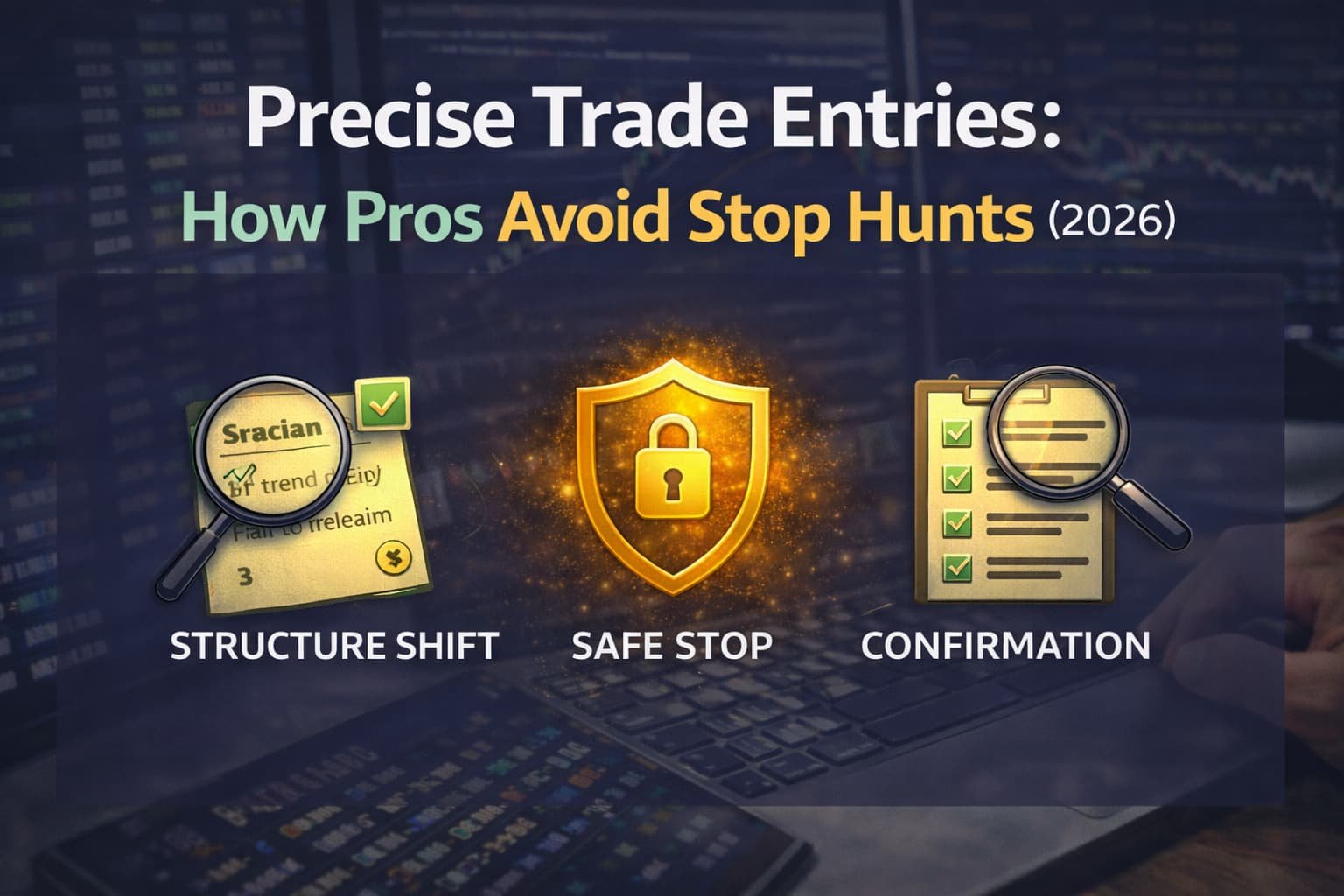
This post is about fixing that, using a simple idea: pros don’t “guess the zone.” They confirm the zone, then they enter with precision inside it.
Not by stacking 12 indicators. Not by worshipping one trading religion. By understanding what every strategy shares.
What all strategies secretly have in common
People argue about names: ICT, SMC, RTM, classic price action, order flow… cool.
Under the hood, they all revolve around the same three concepts:
A meaningful area (zone) where price has a reason to react
A shift in behavior (confirmation) that the area is actually respected
A precise trigger (entry) so your stop isn’t a joke
Most traders stop at concept #1. That’s why they get hunted.
What “real money” looks like on a chart
Big money can’t enter like retail. They can’t just click “buy $1B” and move on with their day.
If someone needs size, the market needs the other side. Liquidity. Inventory. People to trade against.
That’s why the cleanest “smart” zones usually show this sequence:
The market looks undecided (not a flat line, just messy, hesitant price).
Then a sharp move happens.
Often you’ll see imbalance / Fair Value Gaps because price moved too fast for “clean” trading.
That sharp move is the clue. It’s the market basically saying: “Something bigger than random retail is involved here.”
Not every supply/demand zone is equal.
A zone that created a weak drift is not the same as a zone that launched a violent displacement.
The filter that fixes 80% of entry pain: confluence without overthinking
Instead of obsessing over the label (order block vs breaker vs whatever), you get a cleaner result if you do this:
If multiple “types” of traders would agree on the same zone, that zone matters more.
A simple support/resistance area that also lines up with your supply zone and also lines up with the origin of displacement… that’s not magic. That’s just shared attention.
Shared attention = liquidity = reaction potential.
The sniper entry framework (how it actually works)
This method is built on one idea:
Use a higher timeframe to choose the battlefield, then use lower timeframes to pick the exact entry point.
Here’s the flow:
You mark a higher-timeframe zone (where a reaction should happen).
When price enters that zone, you drop down in timeframe and wait for a Market Structure Shift (MSS).
I’m not talking about fancy naming wars. I mean this:
In a bearish context, price stops making lower highs and starts breaking a key swing high.
In a bullish context, price stops making lower lows and starts breaking a key swing low.
That “break” is the market telling you: “Okay, the zone is doing something.”
Now you don’t have to guess. You’re reacting to behavior.
Why “two timeframes down” matters
If you’re trying to do precision entries, doing it off a random micro timeframe is how you get chopped to death.
A simple rule that keeps things sane:
If your main analysis is on 4H, you confirm on 1H, and you enter on 15m (or 5m if you want tighter).
If your main analysis is on 1H, you confirm on 15m, and you enter on 5m/1m.
You’re not zooming in to feel busy. You’re zooming in to confirm that the zone is active.
Two types of entries: “Extreme” vs “Triggered”
This is where most people mess up.
Some zones are “extreme.” If price reaches the deepest level, that’s basically the market screaming. You don’t need fancy confirmation there. It’s the last line.
But most of the time, you’re not getting the perfect extreme tap. So you need a “triggered” entry.
Triggered entry means: price hits your zone, shifts structure, then gives you a clean place to enter (like an FVG retest, a breaker-like area, or the origin of the shift).
The goal is simple:
Let the zone prove itself first. Then enter where your stop makes sense.
That’s how you stop getting clipped and then watching price run your direction without you.
Where the stop goes (without making it massive)
This is the trade-off people don’t want to accept:
If you want a safe stop, you usually pay with R:R.
If you want big R:R, you usually pay with more stopouts.
The sniper method solves it by placing the stop based on the entry type:
If you’re entering at the extreme, the stop can be tighter because you’re near the boundary.
If you’re entering on a trigger inside the zone, your stop needs to be placed beyond the structure that “proved” the move.
No “hope stops.” No “because I feel like it.”
What this fixes immediately
This approach fixes three beginner killers:
You stop entering inside a zone just because price touched it.
You stop widening stops just to survive randomness.
You stop missing trades because your entry was too perfect to ever fill.
You’re basically moving from “prediction mode” to “execution mode.”
A quick visual roadmap (so you don’t overcomplicate it)
| Stage | What you’re doing | What you’re looking for |
|---|---|---|
| HTF Scan | Mark meaningful zone | Clear displacement / imbalance origin |
| Price Enters Zone | Stop guessing | Let price “show its hand” |
| LTF Confirmation | Watch structure | Market Structure Shift (MSS) |
| Entry | Choose precision point | Retest / trigger inside zone |
| Stop + Target | Make it logical | Stop beyond invalidation, target opposing liquidity |
The bottom line
If you’re always getting stopped out right before the move, it’s rarely because “the market hates you.”
It’s usually because your entry process is missing one layer:
Confirmation inside the zone.
Mark the battlefield with HTF zones.
Wait for the market to confirm the zone is respected.
Enter with precision after the shift.
That’s how you trade like a sniper instead of a random guy throwing darts at rectangles.