
Free Resource
Futures Trading Sessions Explained: When Liquidity Is Real (and When It’s Just Noise)

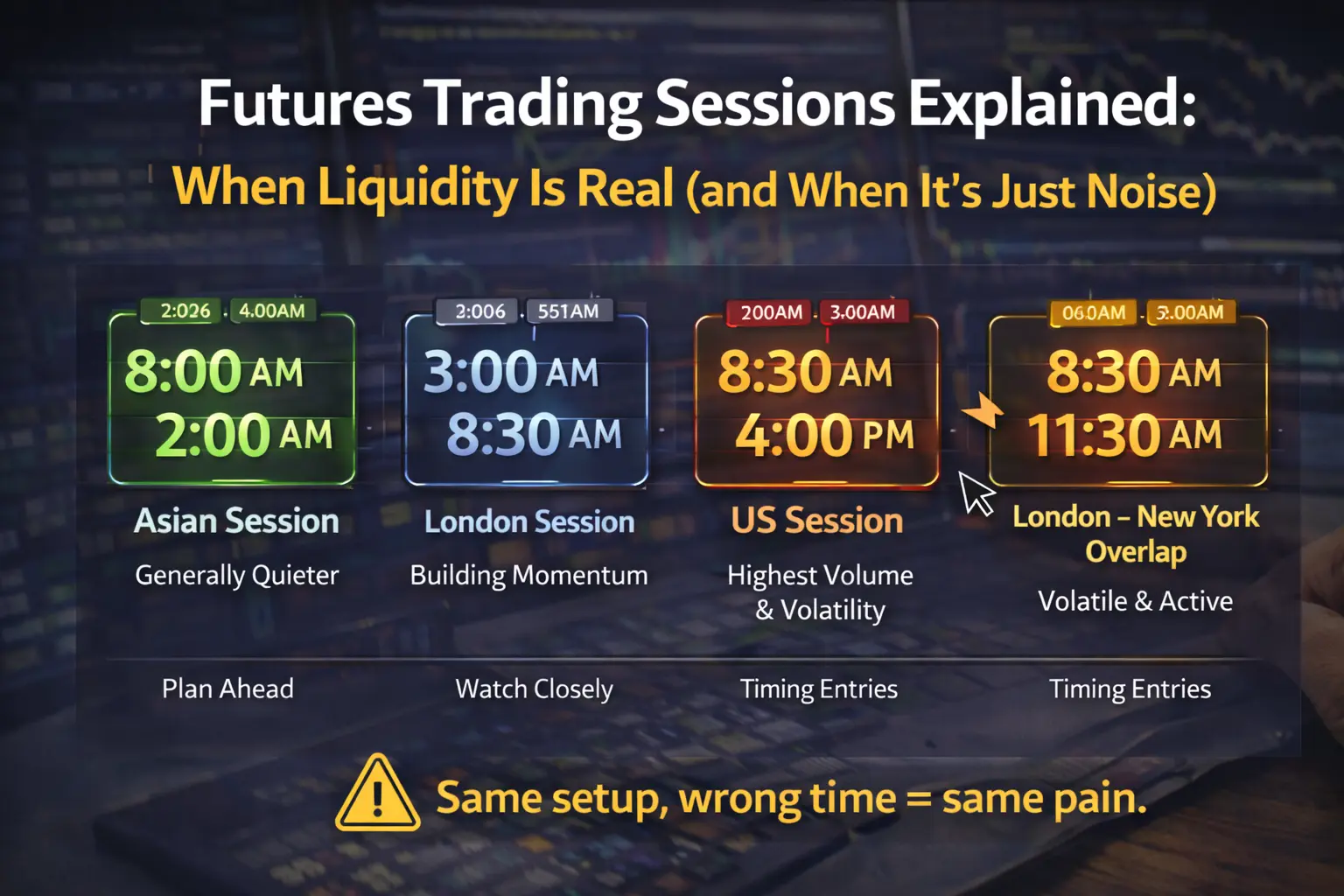
If you’ve ever looked at the futures chart and thought, “Why was it dead for hours, then turned into a knife fight for 30 minutes?” congratulations, you’ve discovered the one thing most beginners ignore: futures trading sessions.
Yes, futures trade almost 24 hours. No, that does not mean every hour is tradable.
Most “new-ish” traders don’t actually have a strategy problem. They have a timing problem. They take the same setup at 2:00am ET (thin liquidity, random wicks, spread nonsense), then wonder why it fails… and then they see the same setup at 9:35am ET and it works like magic.
It’s not magic. It’s participation.
So here’s the clean way I think about sessions, what they usually feel like, and how you can stop donating money during the dead zones.
The quick map (print this in your brain)
Below is the “I don’t have time for a 9-part course” table. Use it as your default until you have a real reason to break it.
| Window (ET) | What it usually feels like | Best for | Worst for |
|---|---|---|---|
| 5:00pm–8:00pm | Post-close dead zone + resets | Planning, marking levels, setting alerts | Trading live entries |
| 8:00pm–2:00am | Asia session (generally quieter) | Range work, patient limit orders | Momentum chasing |
| 3:00am–8:30am | London build-up (volume rising) | Breakouts forming, trend development | Tight stops in chop |
| 8:30am–11:30am | US open + news + overlap | Real moves, clean momentum, day trades | Overtrading + emotional revenge trades |
| 11:30am–2:30pm | Midday (varies by contract) | Selective continuation trades | Scalping garbage |
| 2:30pm–4:00pm | Late session (positioning/closing) | Secondary moves, closes/reversals | Random “one last trade” |
Times are approximate and Daylight Saving Time can shift what “London open” feels like. Also, contracts behave differently (ES vs CL vs GC vs 6E). This table is the baseline, not scripture.
Here’s the quote I wish someone tattooed on my forehead when I started:
“If your setup only works when liquidity shows up, your setup isn’t broken. Your timing is.”
Now let’s make it practical.
Why futures trading sessions matter more than your indicator settings
Futures trading sessions aren’t just “clock time.” They’re a proxy for who is actually participating.
When big participants show up (institutions, hedgers, market makers doing real business), you usually get:
- tighter spreads
- cleaner fills
- follow-through (moves that actually continue)
- less “random wick” nonsense
When they don’t, you usually get:
- choppy price action
- fake breakouts
- weird stop runs that go nowhere
- setups that look perfect and then die because nobody cares
This is why two traders can trade the “same” strategy and get totally different results: one is trading when the market is alive, the other is trading when it’s half-asleep.
The three main sessions (and what beginners get wrong about each)
Asian session: quiet doesn’t mean “safe”
A lot of beginners hear “Asia is slower” and assume that means lower risk. Not necessarily.
Yes, price can move more slowly. But slower markets can also mean:
- thinner order books
- wider spreads in some contracts
- more “drift” and random tagging of levels
In general, I treat the Asian session as a range-building window. Great for watching how a range forms, where liquidity piles up, and where the market might react later.
If you’re a beginner trying to scalp momentum at 1:00am ET, you’re basically practicing pain tolerance.
London session: the market starts acting serious
The London session is where you often see futures start behaving like they have somewhere to be.
A common pattern:
- Asia forms a range
- London tests one side, sometimes breaks it
- then we either trend or set up the real move into New York
London is also where FX futures (like 6E/6B/6J) tend to feel more “normal” because Europe is actually awake and participating.
US session: the main event
For US index futures (ES, NQ, YM, RTY), the US session is where the volume and decisions typically happen.
The US open is violent because:
- overnight positioning gets adjusted
- real money steps in
- scheduled data releases hit
- retail traders try to be heroes (and get punished)
This session is the best and worst thing for beginners. Best because moves are real. Worst because it tempts you into taking five trades in ten minutes because your brain thinks you’re in a video game.
The overlap windows: where “good trading” actually shows up
Overlaps matter because liquidity stacks. Two regions are active at the same time, so price tends to move with more intent.
London–New York overlap (the big one)
This is where a lot of the best intraday movement happens. You’ll often see:
- breakouts that actually hold
- strong continuation moves
- cleaner reactions at key levels
It’s also where you’ll get the sharpest reversals, especially around news.
Asia–London overlap (smaller, still useful)
This can be a “transition” window where you see early positioning. Not always explosive, but often informative.
Exchange hours vs “session behavior” (don’t confuse them)
Yes, CME Globex runs almost around the clock. But exchange hours are not the same thing as tradable conditions.
If you want official schedules (and you should, because rules change and DST makes liars out of everyone), use the exchange’s own pages. CME has an official overview here:
CME Group markets and trading hours
That’s enough links. You’re welcome.
How I choose my trading window (without turning it into a religion)
I start with two questions:
- What contract am I trading?
- Do I want momentum or structure?
If I’m trading ES/NQ and I want clean volume, I’m usually focused on:
- the US open window
- the London–NY overlap
If I’m trading something like gold (GC) or crude (CL), I still care about the US session, but I also respect that those markets can move off global headlines, inventory reports, macro data, and risk-on/risk-off flows that show up in Europe too.
The important part is this: I don’t force trades just because I’m “available.” If the market is in a dead window, I treat it like a gym rest day. You don’t get stronger by doing junk reps.
The session-based mistakes that quietly wreck beginners
I’m not doing a big “Top 10 mistakes” list because you asked me not to. Good call. But these are worth saying.
First: trading the dead zone like it’s the US open.
Second: ignoring news timing.
Third: forgetting DST shifts and then being confused why “London open” looks different.
Fourth: taking tight-stop scalps in thin liquidity and acting shocked when wicks hunt you.
Fifth: treating every session the same across every asset. ES is not CL. CL is not 6E. The market has different personalities.
A practical way to use futures trading sessions in your strategy
Here’s the simplest way to integrate sessions without rewriting your whole life.
Step 1: Pick one session to specialize in
If you’re learning, pick one window and get reps there. I’d rather see someone get good at one session than be mediocre across five.
Step 2: Define what you trade in that session
Are you trading:
- range breaks?
- pullbacks?
- reversals?
- continuation?
Pick one primary behavior. The market prints all behaviors. Your job is not to trade all of them.
Step 3: Adjust risk by session
I’m not telling you what size to trade. I’m telling you the reality:
- thinner liquidity = more slippage risk
- choppy windows = more stop-outs
- high-volatility windows = bigger swings (good and bad)
So if you insist on trading low-liquidity hours, you better have a plan for it. Most people don’t. They just have hope.
Mini-checklist I actually use before taking a trade
This is short on purpose.
- Am I in a high-liquidity session for this contract?
- Is spread behaving normally (not widening)?
- Is price action directional or just rotating?
- Am I trading into a major scheduled release?
- Does my target have room before the next obvious liquidity pool?
- If I get slipped, does the trade still make sense?
If you can’t answer these quickly, you’re not “missing opportunities.” You’re avoiding bad ones.
Closing thought
Learning futures trading sessions is not about memorizing a clock. It’s about understanding when the market has real participation and when it’s mostly noise.
If you’re struggling, don’t immediately blame your strategy. First ask: “Am I trading this during a window where my setup has a chance to work?”
Because if you keep trading dead hours with live-money expectations, the market will keep teaching you the same lesson. And it doesn’t get nicer the second time.