
Free Resource
Liquidity Trap Trading Strategy Backtest: Does Marco’s Simple Model Actually Work?

Why This Strategy Is Interesting
This liquidity trap trading strategy is interesting because it focuses on one thing most beginners completely misunderstand: where traders are trapped.
Marco’s model is not built around moving averages, RSI, MACD, or a chart that looks like someone spilled neon spaghetti on it. It is built around liquidity, meaning the resting orders sitting around highs and lows, especially stop losses.
The basic idea is simple. Retail traders often enter after obvious breaks of structure, support/resistance reactions, order blocks, fair value gaps, or Fibonacci pullbacks. The market gives them just enough reaction to feel smart, then runs their stops before making the real move.
Pleasant little business model. The market lets beginners build the trap, then charges them rent.
This strategy is for traders who want a cleaner way to understand direction and avoid chasing every “break of structure” like it personally owes them money. It is especially useful for beginners who are overwhelmed by too many concepts and want one main framework to build around.
Important: This is educational content only. It is not financial advice. No strategy guarantees profit. Test everything in replay or demo before risking real money, because confidence without testing is just expensive imagination.
Strategy Breakdown: The Core Idea
Marco defines liquidity very simply: resting orders in the market. The clearest example is stop losses.
If traders buy from a low, their stop losses usually sit below that low. If traders sell from a high, their stop losses usually sit above that high. That is where liquidity rests.
But there is one important warning: not every high and every low has useful liquidity. This is where beginners usually turn a good concept into chart graffiti.
A high or low matters when it has induced traders into the market.
For example, price breaks a previous high. Retail traders see bullish momentum or a break of structure. Then price pulls back, reacts from a low, and moves away. Those buyers now likely have stops below that low. That low becomes meaningful liquidity.
On the sell side, price breaks a previous low. Retail traders see bearish momentum. Then price pulls back, respects a high, and moves away. Those sellers now likely have stops above that high. That high becomes meaningful liquidity.
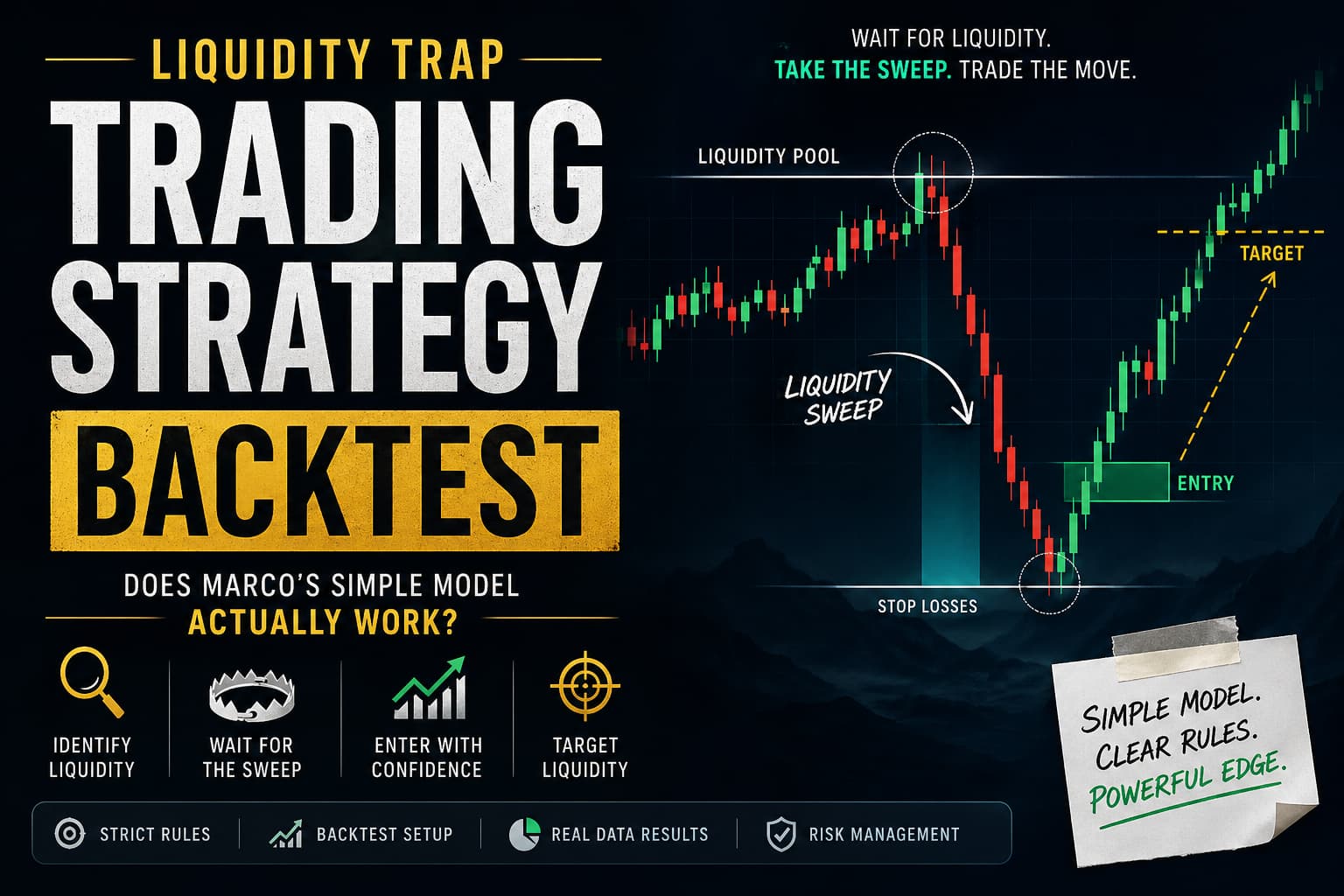
The model is simple: wait for liquidity to build, wait for it to get taken, then trade toward the next liquidity pool.
The key word is wait. A tragic word for traders, apparently.
Strict Rule Set Extracted From the Transcript
1. Liquidity Must Be Built First
The first rule is that liquidity needs to exist before it can be targeted.
Marco repeatedly explains that a trader should not just assume every high and low matters. A useful liquidity level is usually created when price respects a level and moves away, causing traders to enter and place stops behind that level.
- A respected high can create liquidity above it.
- A respected low can create liquidity below it.
- A high or low that has not induced traders may not be useful.
- After a large one-directional move, liquidity may need time to rebuild.
No meaningful liquidity, no trade. If the chart has not built liquidity yet, the best trade may be doing nothing. Horrifying, I know.
2. Long Entry Trigger
A long setup starts with a meaningful low.
This low usually forms after buyers have been induced into the market. For example, price breaks a high, traders see bullish structure, price pulls back, reacts from a low, and moves away. That low now likely has stop losses below it.
Marco’s strict long rule is simple:
If I want to buy, I will not buy until the relevant low is taken.
Strict long rules:
- Identify a meaningful low where buyers were likely induced.
- Confirm price respected that low and moved away.
- Wait for price to trade below that low.
- Do not buy before the low is taken.
- After the sweep, look for a buy entry.
- Stop loss goes below the swept low or execution structure.
- Target opposing liquidity above price.
The long entry is not “price is cheap.” Marco even pushes against the lazy buy-low/sell-high mindset. The entry is based on liquidity being taken first.
3. Short Entry Trigger
A short setup starts with a meaningful high.
This high usually forms after sellers have been induced into the market. For example, price breaks a low, traders see bearish structure, price pulls back, respects a high, and moves away. Those sellers likely have stop losses above that high.
Marco’s strict short rule:
If I want to sell, I will not sell until the relevant high is taken.
Strict short rules:
- Identify a meaningful high where sellers were likely induced.
- Confirm price respected that high and moved away.
- Wait for price to trade above that high.
- Do not sell before the high is taken.
- After the sweep, look for a sell entry.
- Stop loss goes above the swept high or execution structure.
- Target opposing liquidity below price.
This is why the model feels backwards at first. When many traders see a breakout and pullback, Marco may see induced liquidity. He waits for those traders to get trapped before entering.
4. Fractal Execution Model
The same idea works across timeframes.
Marco may use a higher timeframe to identify the larger liquidity target, then drop to a lower timeframe for the entry. The lower timeframe uses the same logic: identify liquidity, wait for a sweep, then trade toward opposing liquidity.
Example:
- Higher timeframe shows liquidity below a major low.
- Price sweeps that low.
- The trader now looks for buys.
- On the lower timeframe, price creates another small trap.
- The lower timeframe low is swept.
- The trader enters long toward internal and external highs.
This is useful, but also dangerous for beginners. Once you learn the concept, every tiny swing starts to look like a “liquidity trap.” Congratulations, you have discovered a new way to overtrade.
5. Session Filters
Marco strongly prefers having a specific trading window.
- He focuses heavily on New York session.
- For futures, he watches stock market open at 9:30 a.m. New York time.
- He often waits until after the open.
- He says what happens outside his planned window is not part of the plan.
- He mentions that London moves may happen, but they are irrelevant if London is not his session.
Exact full trading window: Not specified in the video.
The examples mainly use index futures such as YM and NQ during New York session.
6. News Filter
News is mentioned in the live trading section.
Marco says he does not enter before news. He waits until the news is released and then reacts to the price action after the spike.
- No entry before news.
- Wait for the news event to release.
- Then look for liquidity sweeps and reactions.
- He mentions waiting a few minutes after news in one example.
Exact mechanical news rule: Not specified in the video.
7. Asset Filter
The transcript includes examples on:
- YM / Dow Jones futures
- NQ / NASDAQ futures
- EUR/USD as a higher timeframe discussion example
Marco says newer traders should probably limit themselves to two or three assets on the watchlist.
Exact market list: Not specified in the video.
8. Stop Loss Logic
Stop loss placement is clean.
For long trades:
- Stop goes below the swept low.
- Stop can also go below the lower timeframe execution structure.
- If price goes below that level, the buy idea is wrong.
For short trades:
- Stop goes above the swept high.
- Stop can also go above the lower timeframe execution structure.
- If price goes above that level, the sell idea is wrong.
On futures, Marco says he can place the stop very close, often one or two ticks above or below the key level, because the market is centralized and there is no forex-style spread issue.
For forex, he says more buffer may be needed because spreads and feeds vary.
9. Take Profit and Exit Logic
Marco does not like random fixed-R exits.
He does not want to take partials at 1:3 or 1:5 just because the number looks neat. His point is simple: if you are analyzing liquidity, then targets should also be based on liquidity.
Target logic:
- For buys, target opposing highs where sellers may be trapped.
- For sells, target opposing lows where buyers may be trapped.
- First target can be internal liquidity.
- Final target can be external or higher timeframe liquidity.
- He may take partials at the first liquidity target.
- He may hold the rest toward the higher timeframe target.
Partial-taking:
- He mentions possibly taking 50% or 70% if confident.
- He is not generally a heavy partial-taking trader.
- Exact fixed partial rule: Not specified in the video.
Break-even logic:
- He is not a big fan of moving to break even too early.
- He may move to break even after partialing or closing most of the position.
- He may trail behind a new structural low in a long trade.
- He may trail behind a new structural high in a short trade.
Exit warning: If you enter from liquidity logic but exit from random fear, you are no longer trading the strategy. You are just doing emotional accounting with candlesticks.
10. Position Sizing
The transcript does not give a fixed risk percentage per trade.
The live example mentions:
- He entered with five micros on NQ.
- He added another three contracts during the trade.
- He traded across four accounts.
- The final live result was around $6,400 across four accounts.
Exact position sizing model: Not specified in the video.
For testing, I would use fixed fractional risk, such as 0.25% to 1% per trade, but that would be my testing assumption, not Marco’s stated rule.
Quick Playbook
| Step | What I’m Checking | Exact Rule | Why It Matters |
|---|---|---|---|
| 1 | Higher timeframe liquidity | Mark external highs/lows where traders were likely induced. | This gives the main target and directional context. |
| 2 | Meaningful liquidity | Only use highs/lows that respected price and moved away. | Not every high or low has useful liquidity. |
| 3 | Trap direction | For buys, wait for the key low to be taken. For sells, wait for the key high to be taken. | This avoids entering before the trap is complete. |
| 4 | Session | Focus on the planned time window, mainly New York session in the examples. | Keeps you out of random dead-hour trades. |
| 5 | News | Do not enter before news. Wait for the spike and reaction after release. | News can create the liquidity sweep. |
| 6 | Entry trigger | Enter only after the key high/low has been swept. | The trade starts after liquidity is taken, not before. |
| 7 | Stop loss | Long stop below swept low. Short stop above swept high. | That level invalidates the trade idea. |
| 8 | First target | Target nearest opposing internal liquidity. | This is where the first reaction may happen. |
| 9 | Final target | Hold remaining position toward external or higher timeframe liquidity. | The bigger move usually comes from larger liquidity draws. |
| 10 | Trade management | Trail behind structure and avoid random R-based exits. | The chart decides the exit, not a cute spreadsheet number. |
Backtest Setup
I tested it in TradingView Strategy Tester using a script built from the rules above, with assumptions listed below.
The transcript does not provide a fully mechanical strategy. It provides a discretionary framework. That means a perfect automated backtest is not possible unless we translate the logic into strict rules.
This is where trading gets annoying in the most predictable way. A trader can say, “That low induced buyers.” A script needs exact definitions: how many candles, what type of reaction, how far price moved away, and what counts as a sweep.
So the backtest version is a simplified version of Marco’s liquidity trap model, not an exact clone of his eyes, experience, or execution.
Data and Time Range
The transcript does not state a historical backtest range.
Data/time range tested: Not specified in the video.
For a clean test, I would use:
- Market: NQ futures or YM futures
- Context timeframe: 15-minute or 30-minute
- Execution timeframe: 5-minute or 1-minute
- Session: New York session after 9:30 a.m.
- Minimum sample: 100 trades
- News rule: no entry before major news
- Setup rule: only trade after meaningful liquidity is built and swept
Signal Generation
Signals were generated using TradingView Strategy Tester with a script based on the extracted rules.
Assumptions used:
- A meaningful high forms when price respects a prior high and moves away.
- A meaningful low forms when price respects a prior low and moves away.
- A sweep occurs when price trades above a meaningful high or below a meaningful low.
- Long entries happen only after the relevant low is swept.
- Short entries happen only after the relevant high is swept.
- Stops are placed beyond the swept high/low.
- Targets are opposing liquidity levels.
- Trades are filtered to New York session.
- News handling is simplified because the transcript does not provide exact mechanical rules.
Backtest limitation: This test can only approximate the strategy. Marco’s actual model relies on discretion, chart-reading, timing, and liquidity interpretation. A script can test the skeleton, not the full trader.
Results on Real Data
If You Want to Use This
The first thing I would do is stop marking every high and low as liquidity. This is the fastest way to ruin the model.
A useful high or low needs a story behind it. Did price respect it? Did traders likely enter there? Did price move away enough to leave stops behind? If yes, it may matter. If not, it may just be a random bump on the chart.
My Practical Adjustments
- Start with only two timeframes. Use the 15-minute or 30-minute chart for context, then the 5-minute chart for entries. Do not begin with six timeframes unless your goal is to lose both money and personality.
- Use one strict rule. For buys, wait for the low to be taken. For sells, wait for the high to be taken. If that does not happen, no trade.
- Use liquidity-based targets only. Do not take profit randomly at 1:3 just because a spreadsheet made you feel organized.
What to Watch Out For
This strategy needs patience. Sometimes the setup takes hours. Sometimes it takes days. Sometimes the market moves without you. That is not a problem. That is just the cost of having rules.
If price moves without sweeping your level, Marco’s rule is clear: it was not your trade.
This is difficult for beginners because they see price moving and immediately feel betrayed by the universe. But missing a move is not the same as losing money. Chasing a move is usually how you manage both.
Risk Management Reminders
- Use small size while learning.
- Do not scale in unless the scale-in follows the same rules.
- Do not trade before major news.
- Do not trade outside your planned window.
- Trail behind structure, not fear.
- Take profits at liquidity, not random emotional comfort zones.
If I were simplifying this for a beginner, I would only trade one setup: New York session, clear higher timeframe liquidity target, key high/low swept, entry after the sweep, stop beyond the sweep, target opposing liquidity.
Verdict: Does It Work?
Yes, but only if you respect the waiting part.
This liquidity trap trading strategy works as a framework because it gives the trader a clear reason for direction, entry, stop placement, and target selection.
The model is not magic. It is not automatic. It still requires chart time and discipline. But the foundation is strong because it forces you to think about who is trapped, where stops are likely resting, and where price may want to move next.
My score: 8/10
I like it because it is simple, logical, and avoids indicator clutter. I do not score it higher because beginners can easily misuse it by calling every random high and low liquidity. Naturally, humans found a way to ruin even simplicity.
Reader Questions I’d Expect
Can beginners use this liquidity trap trading strategy?
Yes, but only in demo or replay first. The concept is simple, but reading meaningful liquidity takes practice.
Does every high and low count as liquidity?
No. Marco specifically says this is a common mistake. A useful high or low needs traders induced around it.
What timeframe should I use?
The transcript uses 30-minute, 15-minute, 5-minute, and 1-minute examples. For beginners, I would start with 15-minute context and 5-minute execution.
Should I take profit at fixed R multiples?
Not with this model. Marco prefers liquidity-based targets instead of random 1:3 or 1:5 exits.