Free Resource
I Summarized the ICT 2022 Mentorship So You Don’t Have To

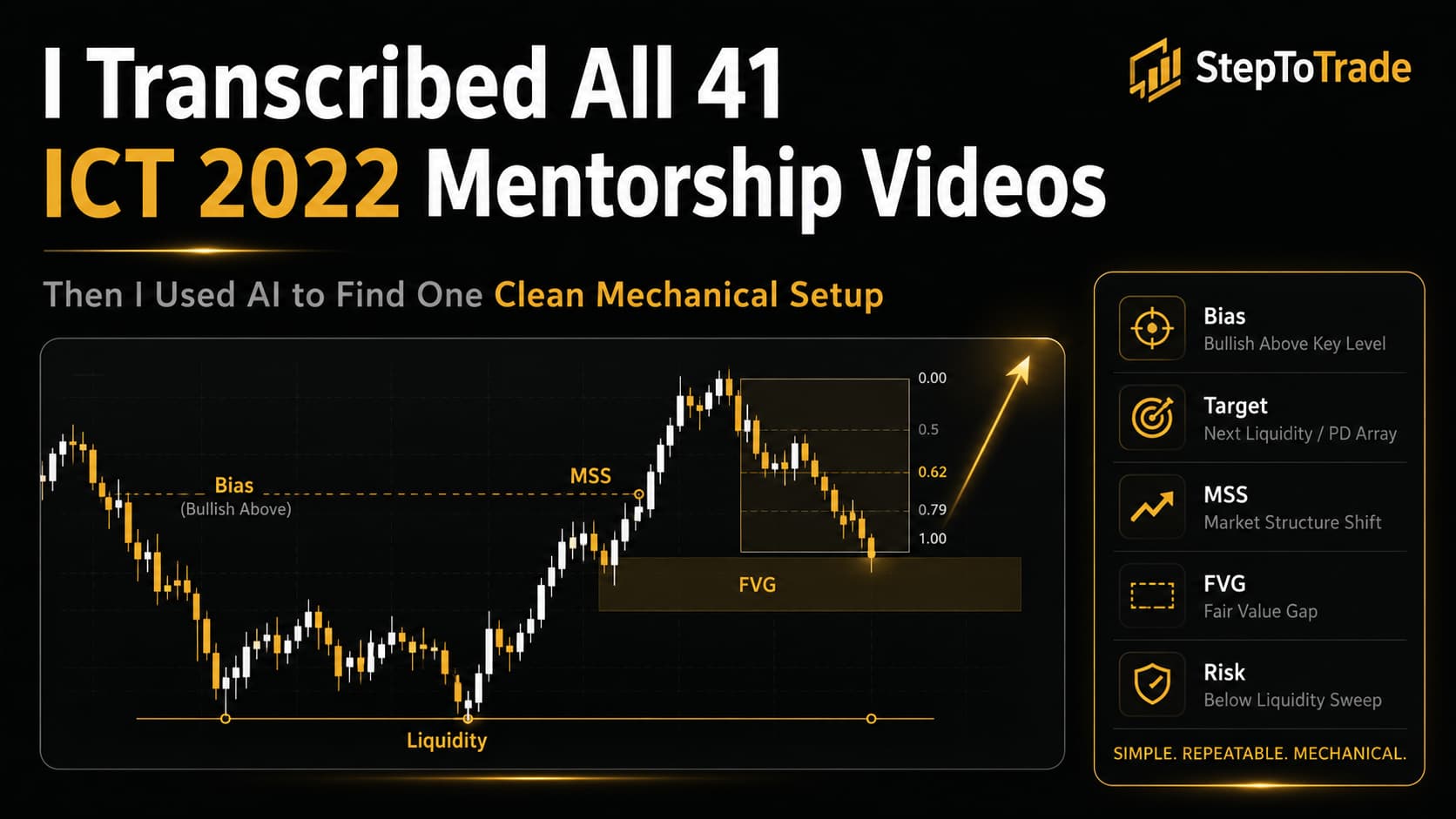
I went through the ICT 2022 mentorship and boiled it down into one practical solo-trader model. Not every concept. Not every rabbit hole. Not the part where a beginner opens six charts and starts seeing liquidity in the toaster. Just the usable core: bias, liquidity, displacement, Fair Value Gap entries, and risk.
The cleanest beginner version is a EUR/USD New York Killzone FVG setup. You identify bias, wait for liquidity to be taken, wait for displacement, mark the Fair Value Gap, enter on the retrace, manage risk, and stop after one clean trade. Stunningly boring. Which is exactly why it has a chance.
The Big Idea: Price Is Reaching for Liquidity
The whole model starts with one question: where is price likely drawing next? That draw is usually an old high, old low, equal highs, equal lows, a previous day high, a previous day low, or a higher-timeframe imbalance.
Above old highs sits buy-side liquidity. Below old lows sits sell-side liquidity. The setup is not about predicting every candle. It is about waiting for price to reach a meaningful area, then seeing whether it continues or reverses.
| Term | Simple Meaning | How It Is Used |
|---|---|---|
| Buy-side liquidity | Stops and breakout orders above highs | Possible target for bullish price delivery or reversal zone after a sweep |
| Sell-side liquidity | Stops and breakout orders below lows | Possible target for bearish price delivery or reversal zone after a sweep |
| Draw on liquidity | The level price is likely reaching for | Defines the direction you are allowed to hunt |
| Fair Value Gap | A three-candle imbalance | Used as the retracement entry area after displacement |
Bias Is Not a Magic Daily Forecast
One of the biggest lessons from the mentorship is that everyday bias is unrealistic. You are not supposed to know the direction every single day. You are supposed to trade only when the higher-timeframe draw, calendar, session timing, and lower-timeframe structure agree.
For a solo trader, this is good news. You do not need to trade daily. You need a few clean setups that repeat often enough to build skill without feeding the market your entire emotional range.
Rule: If the higher-timeframe draw is unclear, there is no trade. Do not open the one-minute chart and start hallucinating opportunity. The market already has enough volunteers.
The Setup: Sweep, Displacement, MSS, FVG
The entry model is simple, at least in theory. First, price sweeps liquidity. For a short, it sweeps a high. For a long, it sweeps a low. Second, price displaces in the opposite direction with strong candles. Third, price breaks market structure. Fourth, a Fair Value Gap appears. Fifth, price retraces back into that gap.
That retrace is the entry. Not the sweep. Not the first candle. Not the moment your nervous system starts yelling at you. The retrace into the valid FVG is the trade location.
What Is a Fair Value Gap?
A bullish FVG appears in a strong move up when Candle 1 high is below Candle 3 low. The empty price zone between them is the bullish FVG.
A bearish FVG appears in a strong move down when Candle 1 low is above Candle 3 high. The empty price zone between them is the bearish FVG.
If the candles overlap, there is no clean FVG. This one rule saves a lot of garbage trades, which is rude but necessary.
- Bullish FVG: Candle 1 high is lower than Candle 3 low.
- Bearish FVG: Candle 1 low is higher than Candle 3 high.
- No gap: candles overlap, so skip it.
- Best use: after liquidity sweep, displacement, and market structure shift.
Why I Chose EUR/USD for the Solo-Trader Version
The original mentorship used a lot of index futures examples, but the logic also applies to forex. For a trader working a normal schedule in Beijing time, EUR/USD during the New York Killzone is cleaner than trying to force US index setups late at night.
The working window becomes 8:00 PM to 10:30 PM Beijing time. That gives enough overlap with the New York forex session without turning your sleep schedule into a crime scene.
The Daily Playbook
At 6:30 PM Beijing time, open EUR/USD and DXY. Check the calendar. If FOMC, NFP, CPI, a major Fed event, or ECB rate decision is active, skip live trading and study only.
On W1 and D1, mark previous day high, previous day low, last three days highs and lows, equal highs/lows, and any obvious higher-timeframe FVGs. Decide one of three things: bullish, bearish, or no trade.
At 8:00 PM, move to M15 and M5. For a long, wait for a low sweep, bullish displacement, bullish MSS, bullish FVG, then retrace into that FVG. For a short, wait for a high sweep, bearish displacement, bearish MSS, bearish FVG, then retrace into that FVG.
| Time | Action | Decision |
|---|---|---|
| 6:30 PM Beijing | Open EUR/USD and DXY | Prepare, do not trade |
| 6:35 PM | Check economic calendar | Skip FOMC, NFP, CPI, major Fed/ECB events |
| 6:40 PM | Check W1 and D1 | Choose bullish, bearish, or no trade |
| 7:00 PM | Mark M15 levels | PDH, PDL, equal highs/lows, midnight NY open |
| 8:00–10:30 PM | Wait for sweep, displacement, MSS, FVG retrace | One trade max |
The Bullish Setup
Use this only when the higher-timeframe bias is bullish and DXY supports EUR/USD strength.
- Price sweeps a low or trades into discount.
- Price rallies with strong bullish displacement.
- Price breaks a meaningful swing high.
- A bullish FVG forms in discount.
- Price retraces into the bullish FVG.
- Enter long only after the retrace holds.
- Stop goes below the swept low.
- Target nearest buy-side liquidity with a 3 to 5 pip buffer.
The Bearish Setup
Use this only when the higher-timeframe bias is bearish and DXY supports EUR/USD weakness.
- Price sweeps a high or trades into premium.
- Price drops with strong bearish displacement.
- Price breaks a meaningful swing low.
- A bearish FVG forms in premium.
- Price retraces into the bearish FVG.
- Enter short only after the retrace rejects.
- Stop goes above the swept high.
- Target nearest sell-side liquidity with a 3 to 5 pip buffer.
Risk Rules
While learning, risk 0.25% to 0.5% per trade. One trade per day. If it wins, stop. If it loses, stop. If it never appears, stop. This is where most traders suddenly discover they are not traders, they are button collectors.
The stop goes beyond the swept high for shorts or swept low for longs. The target is nearest opposing liquidity, usually with a 3 to 5 pip buffer. Beginner target is 10 to 15 pips or the nearest clean liquidity.
The Real Lesson
The ICT 2022 mentorship is not just a collection of chart patterns. The real lesson is patience. The model only works if you respect the sequence: bias first, liquidity second, displacement third, FVG retrace fourth, risk management always.
The market will often move without you. Let it. The goal is not to catch every move. The goal is to catch the setup you understand well enough to repeat without turning your trading account into a confession booth.
Trade toward the draw before it is hit. After the draw is hit, stop and wait for a new MSS and FVG. That one rule alone removes half the chaos.
Backtesting Requirement
Before live trading, backtest at least 30 examples of this exact setup. Then take 20 demo trades. Every chart should be annotated with bias, liquidity, sweep, displacement, MSS, FVG, entry, stop, target, and result.
If that sounds boring, good. Boring keeps traders alive. Excitement is usually just risk wearing perfume.
Disclosure: This article is educational content for StepToTrade. It is not financial advice. Trading involves risk, and most shortcuts are just losses with better marketing.
Final Takeaway
Trade only when bias, DXY, liquidity, time, displacement, MSS, and FVG all agree. If they do not agree, no trade. That is the whole playbook. Simple, boring, and therefore deeply offensive to people who want trading to feel like a movie.